This monologue doesn’t critique comfort; it attacks stagnation dressed as comfort. Comfort isn’t the enemy; when earned, it’s one of the rewards of discipline. The danger is premature comfort: the kind that arrives before the foundation is built, before the skills are sharpened, before the future has been secured. Rest after effort restores. Comfort before effort sedates.
The world’s a hard place, make no mistake. The rising cost of literally anything, from food, to education, to housing – all essentials for a prosperous future – presents a real and valid challenge for many across all age groups. It’s no surprise that many therefore may settle for the bare minimum they believe they can comfortably live with. There’s no shame in that. An entry-level job is meant to teach discipline, structure, routine, and is usually a good introduction to the workforce and the adult world. But trying to make entry-level work carry the full weight of adulthood in the modern day mistakes a starting point for a structure, a rung for a residence, and quietly normalizes stagnation instead of growth. If that starts becoming your trajectory, there has to be a plan for upgrading yourself – through skill, certification, trade, promotion, transition, or some deliberate path upward and onward.
We all want more for ourselves. More money, more toys, more trips. More ability to maintain and withstand sudden expenses that may go into maintaining the lifestyle we cultivate. Financial remuneration is the most widely-accepted token that a given task (or series of tasks) have value. And that value can vary greatly depending on location, time, and environment. The more risk, preparation, skill, effort, or education a task requires, the greater the compensation offered. It’s the incentive to get people to do it. Society and the world marches on, and one must move with it; staying in one place only gets one left behind. Growing old is inevitable. Growing up, some might argue, is optional, but again, that only lasts so long before reality forces movement and advancement.
Here’s the pushback. Taking time after a hard struggle or period of challenge – be it a day at work, a week, a month, or however long a series of tumultuous and stressful events are, is fine. Everyone needs a safe space and moments to rest. But when that rest becomes escape, when it becomes abdication of growth towards one’s future, stagnation sets in, and with it, rot. Your future self is waiting for you to take action. At a young age, we might not even know what it is we want. Then the question becomes, what do you enjoy? This is where trying different things is important; don’t just dismiss a given job without trying it first. Of course, not many aspire to be a janitor at Wal-Mart.
Old advice posits: “Find what you love and find a way to make money doing it, and you’ll never work a day of your life.” Fine. But most people forget the work, risk, sacrifice, and luck required to make that real. Well and good from multimillionaire CEOs and philanthropists; what many don’t realize is the work it took to build companies like Apple, what it cost Bezos or Bill Gates along the way, as they strived towards something from its humble beginnings all the way to where these massive companies sit today.
No matter what that looks like to you, though, one rule holds true above all others: go where the money is. But bring yourself with you. Find the intersection between what the world rewards, what you can become competent at, and what you can live with doing well. Earn more so your future has more options, more resilience, and fewer chains. Money isn’t the meaning of life, but it does buy options, resilience, breathing room, and the ability to absorb shocks without your whole life buckling.
Of course, the flip side to that is whether you can earn enough to do more than just survive or exist. Hobbies and side gigs like art, streaming and photography are great ways to monetize a hobby or interest, but tend not to command considerable fiscal remuneration. What can you do, then? Pick a career path, something you can, if not necessarily adore, at least not hate. Something that doesn’t slowly kill your soul. Something you’re (as paradoxical as it sounds) at least comfortable with. Not everyone – indeed, very few – will have the drive to create a multibillion dollar industry from the ground up, or be lucky enough to make it happen.
Does that mean give up, before the train even leaves the figurative station? No. But it does mean taking a good long look at your own life. The path towards greatness is almost never made in one or two giant leaps. It is made, over the course of many years, through choices, discipline, and intentionality.
Some people start ahead. Some start behind. Some start in places no one would willingly choose. The climb isn’t fair, equal, clean, or guaranteed. It’s hazardous, humiliating, exhausting, and sometimes brutally slow. But few things are more worthwhile than becoming harder to defeat than your circumstances expected you to be. The world may wound you. Circumstances may slow you. Systems may be unfair. Your upbringing may leave scars. The economy may leave you with less room to breathe. None of that changes the central fact: if you’re capable of movement, refusing to move will still cost you. Explanation isn’t an exemption. Difficulty isn’t destiny. And grievance, no matter how justified it feels, won’t build the life your future self is waiting for.
Want to own a home? Drive a corvette? Get an expensive new toy, or PC upgrades? Or even go to a faraway land? You’ll get there a lot quicker if you earn more. Obviously. Everything you do professionally, when not at rest, ought to be in service of that end-goal, whatever that goal looks like for you personally. The pushback being made here is that that will be much more difficult to do when one chooses safety and comfort over challenge and discipline. Safety matters, obviously, comfort and mental health matter as well, but using the fear of the unknown, a lack of drive, ambition or focus, to cost you your future is doing one’s future self a disservice of great proportion. It may not seem that way now, especially when one is younger, still figuring oneself out, in college or university, finding one’s way, but that’s different and part of the process. The challenge being made here is to not settle for mediocrity or the bare minimum, when you know, deep down, you’re capable of so much more. That’s what’s called the Butterfly Effect: small choices made early, repeated long enough, can change the entire direction of a life.
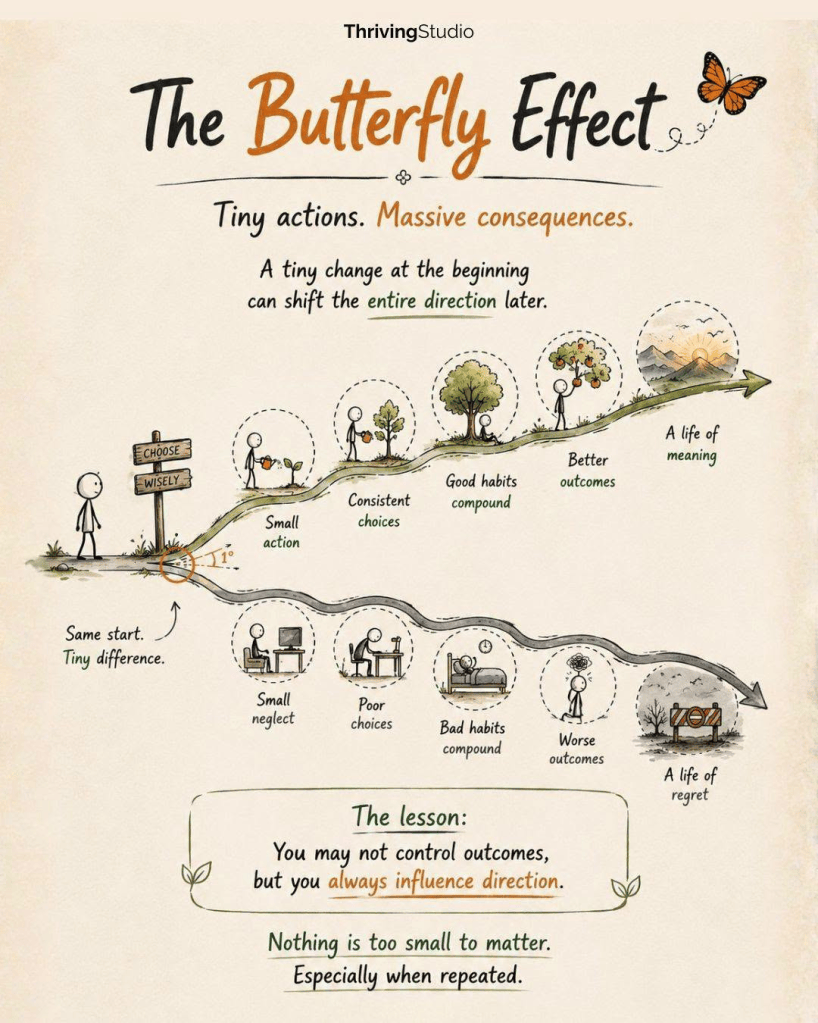
(image courtesy of Thriving Studio on Facebook)
Environment can shape that as well. The people you surround yourself with, the content you watch on social media, the habits and behaviors you do daily may be small and of minimal effect in isolation, but when the same behaviors stretch out over many years, far too many learn far too late the cost of NOT doing things sooner. And there’s no shortage of grievance and outrage content out there to sate and validate those feelings. Again. Validating your feels isn’t nothing, but if it doesn’t motivate or inspire (more) action, your comfort is holding you back.
Effort matters, not just to maintain, but to advance in life. And you don’t build the life of your dreams by dreaming, comparing, narrating, explaining, justifying why you’re not there yet. Comfort isn’t the problem. Refusing to outgrow it is.


Leave a comment